"Accumulated History of the Ancient Stones Tell the History of Men"
How did your interest in natural stone and especially the use of stone in historical buildings begin?
At 20 years old, I qualified as an industrial chemist, and got a two years grant from the English “Italian Art and Archive Rescue Fund” created to help the restoration of Venetian monuments after the 1966 big flood. to work for the Superintendency for Cultural Property of Venice. I started with the scientific examination of damaged mural and easel paintings, but contemporaneously initiated to follow the courses of Geology at the University of Padua, where I graduated in 1974, thus beginning to be interested in marbles and stones used in monuments. In 1974 I graduated in geology, with major in petrography.
What scientific methods do you use to determine the provenance of a stone?
I use standard petrographic and geochemical laboratory methods to characterize unknown lithotypes. and compare the results with relative published databases. I also travelled a lot in the coastal Mediterranean countries visiting known ancient quarries and discovering more than two dozens of unknown ones, sampling and characterising their stones, thus implementing such databases both of coloured stones and white marbles.
In your view, how does knowing and understanding the history of a building material influence architectural design?
Many lithotypes were used in antiquity basing on their geography, history and symbolisms: two examples are the red Egyptian porphyry (from the Gebel Dokhan) that having the colour of pourple was the stone of kings and emperors, and the marmor triponticum (occhio di Pavone = peacock eye. Note that most ancient marbles have been named in Italian, and these names are used internationally) from Kutluca, near Izmit, that recalls the immortality of the soul as symbolized since antiquity by peacoks. So khowing the history of a stone one may give an extra value (social, religious, etc.) to a building material that may strongly influence its choice as a building/decorative material.
What is your opinion about the re-use of ancient stones? How do you perceive the “second life” of a stone; Would you consider this as a form of cultural continuity or rather a response to necessity?
Ancient stones used by the Greeks and Romans were very often re-used in monuments of the Eastern and Western Middle Ages, and later on in Italy during the Renaissance and Baroque periods adding history, prestige and value to them. The difference between a beautiful “ancient” stone, and a beautiful modern one is the accumulated history of the former that can tell the history of men, sometimes in a very complete and direct way. In most cases, the ornamental marbles and stones used in antiquity were of outstanding beauty, and /or of remarkable workability (like white marbles, the best materials for statuary and portraits), so if still available they may well justify their new exploitation. In fact, for example, at the end of the XIX c., and later on for several decades, giallo antico from Tunisia, rosso antico and verde antico , both from Greece, were largely re-exploited with international success.
When restoring a structure that includes stones no longer available today, what are your main criteria in selecting a suitable substitute material?
The main criterion is based on the similarity of colour and texture. In the case of monumenta restoration, it is compulsory to document graphically and photographically the new additions. In Venice it was a common practice to carve the intervention-date on the new marble.
You have researched ancient quarries in Turkey. What initially drew you to this region?
As you may know, Venice in the Late Middle Age re-use many marbles and stones taken from the neighboring Roman towns; later on, especially after the Fourth Crusade, it imported a lot of stony materials from the ancient abandoned towns of the Levante. So, a lot of Proconnesian marble (from the island of Marmara) and many other decorative stones arrived to Venice from Asia Minor, so already in the Seventies I started to study Turkish stones in libraries, museums and archaeological areas as well as traveling in the Aegean coastal areas.
How would you assess the diversity of stone types in Anatolia? Do you have any plans to publish your research in this area as a book?
Anatolia is one of the richest geographical areas as regards dimension stones, and I should say that the Romans discovered the most beautiful stones outcropping along its coasts, and also in several internal regions. Many pure white or grey marbles (eg. the Proconnesian, the Ephesian, Phrygian, Aphrodisian, Heracleotan, etc.), as well as nice breccias (e.g. the breccia corallina from Vezirhan and the Karaburun, the marmor luculleum, also known as africano, from Sigacik, province of Ismir), fossiliferous limestones (like the mentioned occhio di pavone), calcite alabasters (like that of Akhisar, or from Pamukkale), granitoid rocks (like that from the Cigri Dag, or the Kozak area,), etc., have all been used in Roman, and often Ottoman architectures. You may find useful information in 3 extended papers published recently in a book titled “Ancient marbles and stones in Venice” [Bilban has a copy of it, and I may eventually send a copy if you give me a postal address]
In Italy, what is the place of natural stones in education within relevant disciplines (such as architecture, geology, conservation, and restoration)? Are the courses offered on this topic sufficient?
I have been teaching to geologists for six years, and then to architects for twenty years, and I have experienced a great interest in both students’ categories. There is much demand of information about materials, both ancient and modern, and I should say not enough attention to material science in the faculties of Architecture, Engineering and Geology , at least in most Italian universities. I tried to do my best for ancient building materials (stones, bricks, mortars), but I think there should be more specialized courses, also followed by restorers, archaeologists and art historians, especially for those of them involved in the responsibility of preserving the great portion of our Cultural Heritage made of these materials.
Could you share some details about the research you are currently conducting? Is there a particular project or discovery that excites you at the moment?
On one side I am systematically identifying the decorative stones installed in Venetian churches and relevant palaces, and another side, working in the characterization of single rare stones of which we do not know their origin. It is the case of the tephra called “bianco e nero tigrato”, of which we know very little, say its presence in Roman buildings of Italy, Romania, Turkey, and some of its chemical-petrographic features (as resulting from my ongoing laboratory analyses).
Hagia Sophia is one of the most prominent structures you have studied in Turkey. We are especially grateful for your contribution to the upcoming Hagia Sophia book by Stoneline Publication. Considering the period in which it was built, what makes Hagia Sophia unique in terms of the use of natural stone?
The majority of the most important decorative stones used in antiquity are present in Hagia Sophia reflecting the architectural tradition of Rome and Byzanthium, although the very best quality of each stone has been selected and used in a masterly way, especially considering the wonderful book-matching installation of slabs.
Given the extensive research already conducted on Hagia Sophia, what distinguishes your study from previous work on this monument?
As far as I know, nobody has so far published a detailed monograph on the ornamental stones and marbles installed in Hagia Sophia, in spite of the fact that the Basilica is in absolute one of the most beautiful example of marble decoration in the world.
We understand you are involved in ongoing research related to ancient stone use in projects such as Marmora Asiatica and historic cities like Aphrodisias. Are there other sites or regions in Turkey that you are currently working on?
Yes, within that project we already published in international specialized journals the results of a complete scientific archaeometric characterization of the white marbles of Göktepe (province of Muĝla) and of Aphrodisias (Geyre), and we are completing analogous studies for the marbles of Ephesos (Selçuk), Dokymaion (Ishehisar, province of Afyon) and Prokonnesos (Marmara Adası).
How did your interest in natural stone and especially the use of stone in historical buildings begin?
At 20 years old, I qualified as an industrial chemist, and got a two years grant from the English “Italian Art and Archive Rescue Fund” created to help the restoration of Venetian monuments after the 1966 big flood. to work for the Superintendency for Cultural Property of Venice. I started with the scientific examination of damaged mural and easel paintings, but contemporaneously initiated to follow the courses of Geology at the University of Padua, where I graduated in 1974, thus beginning to be interested in marbles and stones used in monuments. In 1974 I graduated in geology, with major in petrography.
What scientific methods do you use to determine the provenance of a stone?
I use standard petrographic and geochemical laboratory methods to characterize unknown lithotypes. and compare the results with relative published databases. I also travelled a lot in the coastal Mediterranean countries visiting known ancient quarries and discovering more than two dozens of unknown ones, sampling and characterising their stones, thus implementing such databases both of coloured stones and white marbles.
In your view, how does knowing and understanding the history of a building material influence architectural design?
Many lithotypes were used in antiquity basing on their geography, history and symbolisms: two examples are the red Egyptian porphyry (from the Gebel Dokhan) that having the colour of pourple was the stone of kings and emperors, and the marmor triponticum (occhio di Pavone = peacock eye. Note that most ancient marbles have been named in Italian, and these names are used internationally) from Kutluca, near Izmit, that recalls the immortality of the soul as symbolized since antiquity by peacoks. So khowing the history of a stone one may give an extra value (social, religious, etc.) to a building material that may strongly influence its choice as a building/decorative material.
What is your opinion about the re-use of ancient stones? How do you perceive the “second life” of a stone; Would you consider this as a form of cultural continuity or rather a response to necessity?
Ancient stones used by the Greeks and Romans were very often re-used in monuments of the Eastern and Western Middle Ages, and later on in Italy during the Renaissance and Baroque periods adding history, prestige and value to them. The difference between a beautiful “ancient” stone, and a beautiful modern one is the accumulated history of the former that can tell the history of men, sometimes in a very complete and direct way. In most cases, the ornamental marbles and stones used in antiquity were of outstanding beauty, and /or of remarkable workability (like white marbles, the best materials for statuary and portraits), so if still available they may well justify their new exploitation. In fact, for example, at the end of the XIX c., and later on for several decades, giallo antico from Tunisia, rosso antico and verde antico , both from Greece, were largely re-exploited with international success.
When restoring a structure that includes stones no longer available today, what are your main criteria in selecting a suitable substitute material?
The main criterion is based on the similarity of colour and texture. In the case of monumenta restoration, it is compulsory to document graphically and photographically the new additions. In Venice it was a common practice to carve the intervention-date on the new marble.
You have researched ancient quarries in Turkey. What initially drew you to this region?
As you may know, Venice in the Late Middle Age re-use many marbles and stones taken from the neighboring Roman towns; later on, especially after the Fourth Crusade, it imported a lot of stony materials from the ancient abandoned towns of the Levante. So, a lot of Proconnesian marble (from the island of Marmara) and many other decorative stones arrived to Venice from Asia Minor, so already in the Seventies I started to study Turkish stones in libraries, museums and archaeological areas as well as traveling in the Aegean coastal areas.
How would you assess the diversity of stone types in Anatolia? Do you have any plans to publish your research in this area as a book?
Anatolia is one of the richest geographical areas as regards dimension stones, and I should say that the Romans discovered the most beautiful stones outcropping along its coasts, and also in several internal regions. Many pure white or grey marbles (eg. the Proconnesian, the Ephesian, Phrygian, Aphrodisian, Heracleotan, etc.), as well as nice breccias (e.g. the breccia corallina from Vezirhan and the Karaburun, the marmor luculleum, also known as africano, from Sigacik, province of Ismir), fossiliferous limestones (like the mentioned occhio di pavone), calcite alabasters (like that of Akhisar, or from Pamukkale), granitoid rocks (like that from the Cigri Dag, or the Kozak area,), etc., have all been used in Roman, and often Ottoman architectures. You may find useful information in 3 extended papers published recently in a book titled “Ancient marbles and stones in Venice” [Bilban has a copy of it, and I may eventually send a copy if you give me a postal address]
In Italy, what is the place of natural stones in education within relevant disciplines (such as architecture, geology, conservation, and restoration)? Are the courses offered on this topic sufficient?
I have been teaching to geologists for six years, and then to architects for twenty years, and I have experienced a great interest in both students’ categories. There is much demand of information about materials, both ancient and modern, and I should say not enough attention to material science in the faculties of Architecture, Engineering and Geology , at least in most Italian universities. I tried to do my best for ancient building materials (stones, bricks, mortars), but I think there should be more specialized courses, also followed by restorers, archaeologists and art historians, especially for those of them involved in the responsibility of preserving the great portion of our Cultural Heritage made of these materials.
Could you share some details about the research you are currently conducting? Is there a particular project or discovery that excites you at the moment?
On one side I am systematically identifying the decorative stones installed in Venetian churches and relevant palaces, and another side, working in the characterization of single rare stones of which we do not know their origin. It is the case of the tephra called “bianco e nero tigrato”, of which we know very little, say its presence in Roman buildings of Italy, Romania, Turkey, and some of its chemical-petrographic features (as resulting from my ongoing laboratory analyses).
Hagia Sophia is one of the most prominent structures you have studied in Turkey. We are especially grateful for your contribution to the upcoming Hagia Sophia book by Stoneline Publication. Considering the period in which it was built, what makes Hagia Sophia unique in terms of the use of natural stone?
The majority of the most important decorative stones used in antiquity are present in Hagia Sophia reflecting the architectural tradition of Rome and Byzanthium, although the very best quality of each stone has been selected and used in a masterly way, especially considering the wonderful book-matching installation of slabs.
Given the extensive research already conducted on Hagia Sophia, what distinguishes your study from previous work on this monument?
As far as I know, nobody has so far published a detailed monograph on the ornamental stones and marbles installed in Hagia Sophia, in spite of the fact that the Basilica is in absolute one of the most beautiful example of marble decoration in the world.
We understand you are involved in ongoing research related to ancient stone use in projects such as Marmora Asiatica and historic cities like Aphrodisias. Are there other sites or regions in Turkey that you are currently working on?
Yes, within that project we already published in international specialized journals the results of a complete scientific archaeometric characterization of the white marbles of Göktepe (province of Muĝla) and of Aphrodisias (Geyre), and we are completing analogous studies for the marbles of Ephesos (Selçuk), Dokymaion (Ishehisar, province of Afyon) and Prokonnesos (Marmara Adası).
We would like to thank again for your time and contribution.
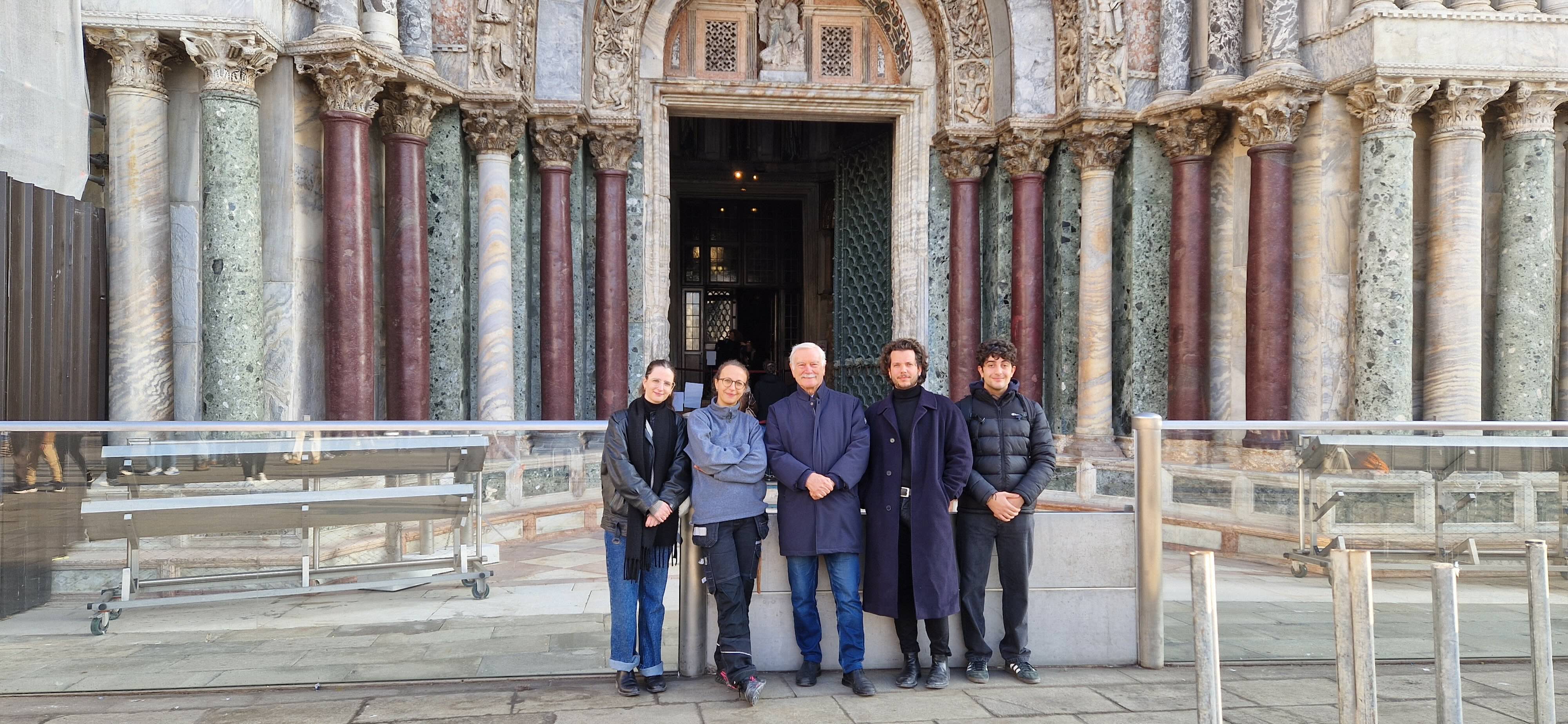
Lorenzo Lazzarini in the middle, between the restorer Francesca and Filippo Gallorini, in Venice... ( 18.11.24 )