Item 1 of 1
Properties
Properties of the Stone
Additional Names
Rouge Griotte
Color
Red
Scientific Classification
Nodular Limestone
Commercial Classification
Marble
Quarry Site
Campan-France
Quarry State Aktif Değil
Inactive
Quarry Location, Geological Origin, and Nomenclature
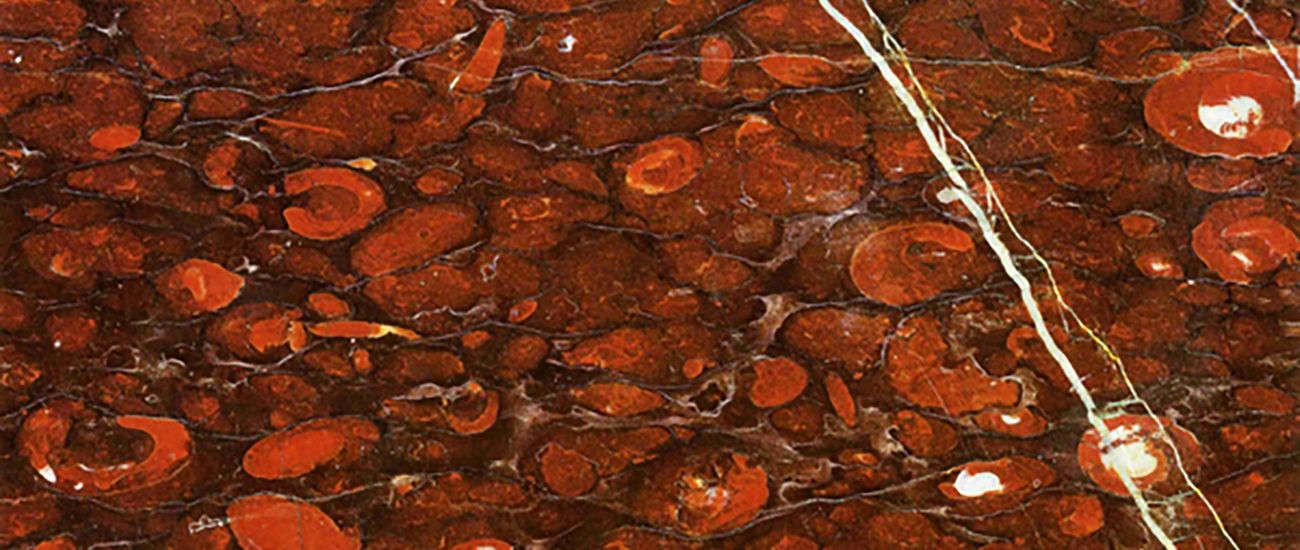
Campanian Marble, quarried in the Campan region of France since antiquity and rediscovered in the 17th century, is known for its deep cherry red color. Classified as ‘Fossiliferous Limestone,’ it features characteristic goniatite fossils filled with white calcite from the Carboniferous period.* Italian stonemasons named it ‘Rouge Griotte.’
Historical References
In Paris, from the 18th century, this stone was used in notable structures such as the Palace of Versailles, the Opéra Garnier, the Louvre Museum, the Arc de Triomphe du Carrousel, and the Carrousel Square as monumental fireplaces, door architraves, and as a frieze in the Arc de Triomphe du Carousel.
In Istanbul, it was used as cladding on the exterior walls and window architraves of the Revan Pavilion in Topkapı Palace, as well as a decorative stone in the minbar of the Laleli Mosque.
*Marc Maiso, Griotte Marble. Accessed on 17 August 2024, at https://www.marcmaison.com/architectural-antiques-resources/griotte_marble
Historical Buildings
Buildings using this stone
_276x160.jpg)
Item 1 of 1