Item 1 of 1
Properties
Properties of the Building
Architect(s)
Mimar Sinan
Construction Completion
1588
Location and Historical Importance
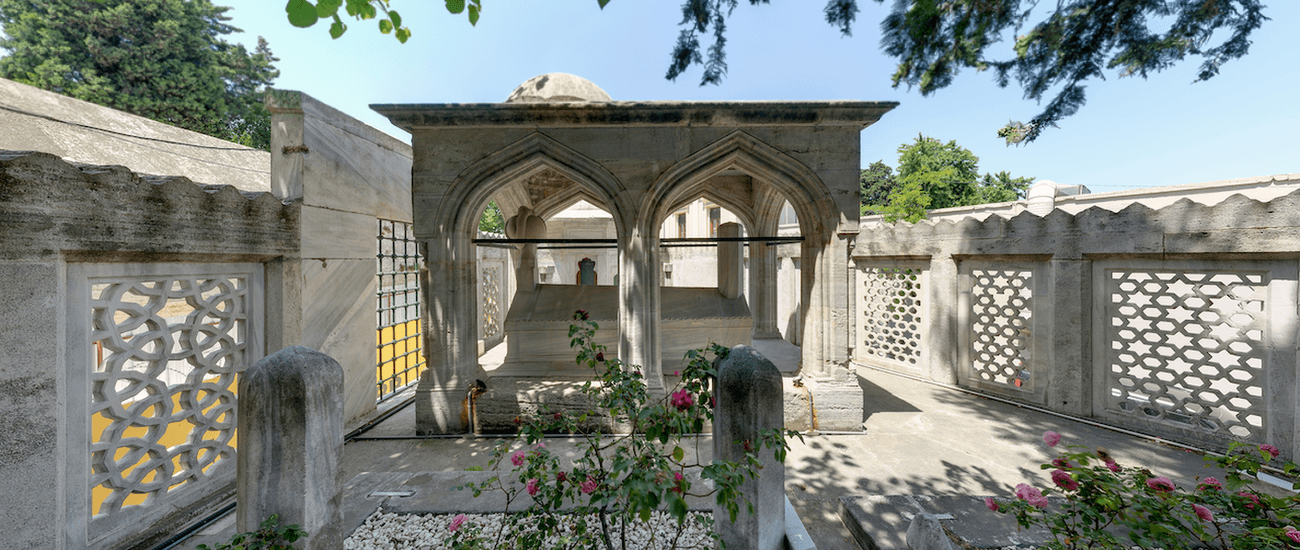
The open tomb of Mimar Sinan is located at the intersection of Mimar Sinan Street and Fetva Hill, next to the eastern wall surrounding the Sülemaniye Mosque, where narrow streets descend from north to south. This is the only instance of where the tomb of an architect can be found next to those of the founder of the complex, Sultan Süleyman the Magnificent, and his wife, Hürrem Sultan.
Architectural Features
High perimeter walls encircle the tomb on two sides. The walls, adorned with large palmette motifs, open to the outside with square windows. These openings are covered with intricate stonework, featuring lattices in the ajour technique, where geometric polygons intersect to form a star at the centre. Above the large pilgrimage window, which features a marble frame and iron grills, is an inscription that ends with the lines of Poet Mustafa Sa'i: 'In this time, from this world passed the master of architects, Sinan.'
The open tomb is quite small in size and modest. The transition to the small, stone dome is achieved with elegant muqarnas, while the flat stone cover behind it is enlivened by geometric, interlocking motifs emerging from an octagonal star. The interiors of the arches are filled with rope mouldings, and pilasters with hourglass-shaped capitals are placed at the corners. On the gravestone at the head of the marble sarcophagus beneath the open tomb, there is a large turban. The headstone is adorned with a foliate decoration carved into the marble, culminating in a large palmette. The fountain, attached to the northern end of the tomb, is a simple marble structure designed with a polygonal plan. The tomb, constructed during the final years of Mimar Sinan's life, was completely restored in 1922, along with the fountain attached to its northern end.
References
Selçuk Mülayim. (2010). 'Süleymaniye Külliyesi', DİA, Vol. 38, İstanbul, pp. 114-119.
Tarkan Okçuoğlu. (1994). 'Mimar Sinan Türbesi', Dünden Bugüne İstanbul Ansiklopedisi, Vol. 5., A Joint Publication of the Ministry of Culture and the History Foundation, İstanbul, p. 470.
Natural Stones
Stones used in this building