
Item 1 of 2
Properties
Properties of the Stone
Additional Names
-
Color(s)
Black, Gray
Scientific Classification
Limestone
Commercial Classification
Marble
Quarry Site
İstanbul / Türkiye
Quarry State
Inactive
Quarry Site, Geological Origin, and Nomenclature
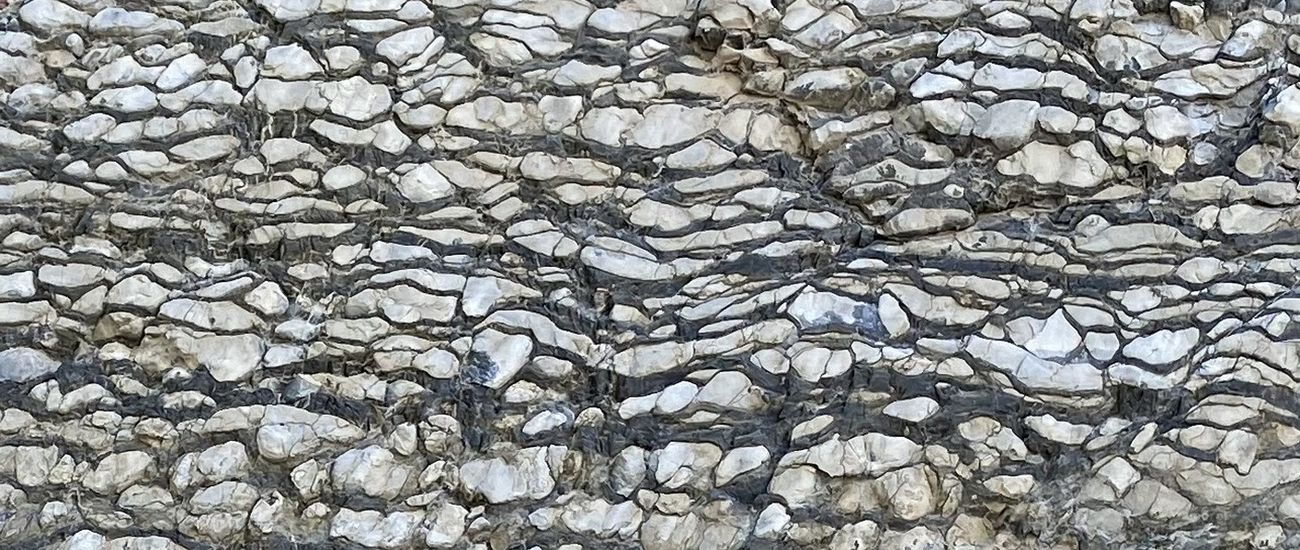
The old quarries of Istanbul Devonian Limestone are densely distributed on both sides of the Bosphorus. The main sites are located in the vicinity of Kanlıca (Körfez), Beykoz (Umuryeri), Beylerbeyi (İstavroz), Kandilli, Kartal, Sedef Island, İstinye, Baltalimani, Kuruçeşme, Eyüpsultan, and Kâğıthane. Geologically, this stone, dating back to the Devonian period, is classified as ‘limestone’ in the scientific literature. Istanbul’s black limestone is dark blue-black in colour with a layered structure, occasionally featuring white, yellow and pink calcite veins.
The light gray nodular limestone found in the upper layers of this limestone, belonging to the same geological period was used as a construction material in various architectural works in Istanbul.
İstanbul Devonian Limestone in Ottoman Architecture
The construction records of Süleymaniye Mosque include an entry (No: 99/a) documenting that workers extracted this natural stone in Beylerbeyi (formerly the village of İstavroz), believed to pertain to this class of stone. Additionally, in the manuscript Risale-i Mi‘mariyye (Treatise on Architecture), his stone is referred to as ‘Mermer-i Üsküdar’ (Üsküdar Marble), ‘Seng-i Siyah’ (Black Stone), and ‘Karataş’ (Black Rock).
Mimar (Architect) Sinan used the black-coloured variety of this stone for interior window mosaic decorations in the Süleymaniye Mosque and for geometric floor decorations along the east and west walls of the mihrab section in the Rüstem Paşa Mosque. The light gray, nodular stones were primarily used as structural stones in arches and walls.
_276x160.jpg)
_276x160.jpg)
_276x160.jpg)
_276x160.jpg)
_276x160.jpg)
_276x160.jpg)