Restoration of Haydarpaşa Station continues
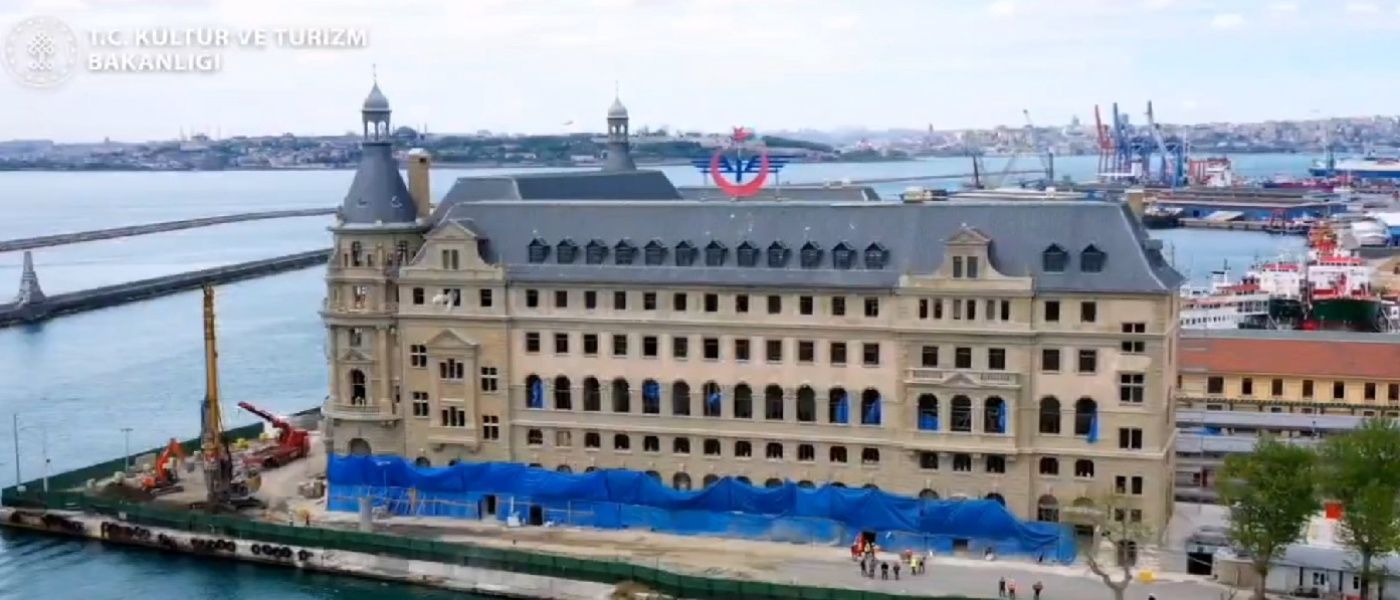
According to a statement from the Ministry of Culture and Tourism (1), restoration and regeneration work is continuing at the historic Haydarpaşa Station – one of the iconic structures in Istanbul’s collective memory, whose roof was damaged in a fire on 28 November 2010. Culture and Tourism Minister Mehmet Nuri Ersoy, who visited the site at the end of May, explained that extensive research had been carried out in the area prior to the restoration work, that the site’s history and heritage had been examined in detail, and that the restoration process was being carried out under the supervision of a Scientific Committee, providing the following information:
'We are not merely restoring Haydarpaşa Station, which has served as Anatolia’s gateway to the world for over a century; we are reintegrating it into the life of Istanbul whilst preserving its historical memory. Whilst preserving its transport function at Haydarpaşa, we are creating one of the most important cultural and community centres on the Anatolian side, featuring libraries, exhibition spaces, digital museum points, an archaeological museum, an archaeopark and event spaces.'
Closed quarries were reopened
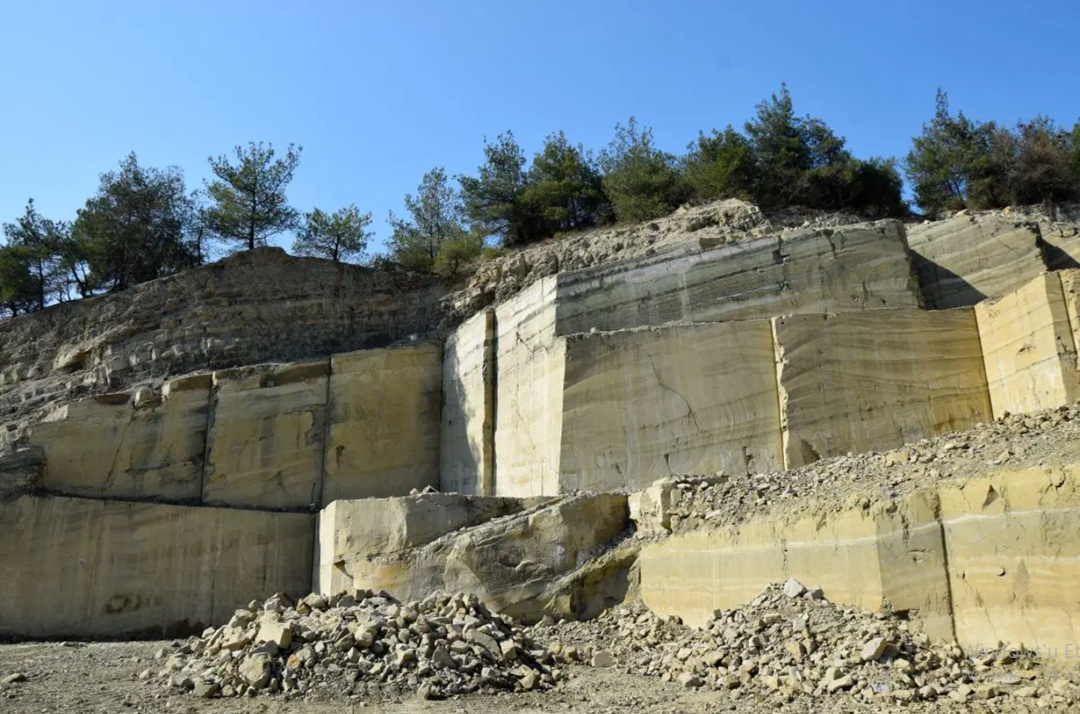
In 2019, Abdulkadir Uraloğlu, then Minister of Transport and Infrastructure, stated that the damaged façade stones had been sourced by reopening the closed Lefke stone quarries in the Osmaneli district of Bilecik. Stone samples extracted from the Osmaneli district of Bilecik were sent to a laboratory, and once it was established that they were an exact match for the stone used on the exterior of Haydarpaşa Station, restoration work continued using stone sourced from the quarry opened there (2).
Natural stones used at Haydarpaşa Station
Lefke Stone (sandstone), sourced from the Osmaneli district of Bilecik, was used as the main building stone on the exterior façade of Haydarpaşa Station. Pink granite was chosen for the ground floor level, whilst slate was used for the roof.
Lefke stone is quarried from quarries in the Osmaneli (formerly known as Lefke) district of Bilecik. When first extracted from the quarry, this stone has a yellowish hue, but over time, as it comes into contact with oxygen, it takes on its characteristic greenish colour. It is a building stone that is easy to work with but requires a high degree of craftsmanship.
Lefke Stone was frequently used in prestigious monumental buildings, station buildings, and religious architecture, particularly during the Late Ottoman and Early Republican periods. It has been used in the Istanbul Bebek and Istanbul Bostancı mosques, designed by architect Kemaleddin Bey, the historic Eskişehir Government House, the Osmaneli Rüstem Pasha Mosque and the Osmaneli Church of St George, and the Historic Osmaneli Houses. In 2023, following an application submitted to the Turkish Patent and Trademark Office by Osmaneli Municipality, with the support of Bilecik Şeyh Edebali University and Istanbul Commerce University, a geographical indication certificate was granted for Lefke building stone.(3)(4)
For the station building, in particular, light pink granite quarried from the Hereke region of Kocaeli was used for the ground floor cladding and foundation beds. Preferred at the time of construction due to their proximity to Istanbul and their location suitable for transport by sea, the Hereke granite quarries provided the durable main structural stone required not only for the ground-floor cladding of the station building but also for the plinth levels and load-bearing foundation beds. As it is highly resistant to high pressure and weather conditions, it was also used on the quays of Haydarpaşa Station. Hereke granite is a hard, monocoloured or mottled igneous rock formed by the solidification of magma, and was selected to bear the heavy load of Haydarpaşa Station’s sea-facing section. [(Korkmaz & Ahunbay, 2011), (General Directorate of Mineral Research and Exploration [MTA], 2018)]
This igneous rock, which is extremely resistant to very high pressure, heavy loads and the corrosive effects of seawater, has generally been used in major engineering projects and infrastructure elements: [5] It was the preferred choice as a foundation material for many Ottoman-era harbour structures, breakwaters and quay walls along the coast of the Sea of Marmara. It was used in the plinths of some administrative buildings within the Hereke Fabrika-i Hümâyûnu (Imperial Weaving Factory) complex, built in the 1890s, and in the single-piece carved granite fountains located in the factory’s historic courtyard (Şenel, 2016). This pink granite was used at the tunnel entrances, bridge piers and load-bearing blocks of culverts along the Istanbul–Kocaeli–Bilecik route of the Hejaz and Baghdad Railway lines (Engin, 2015).
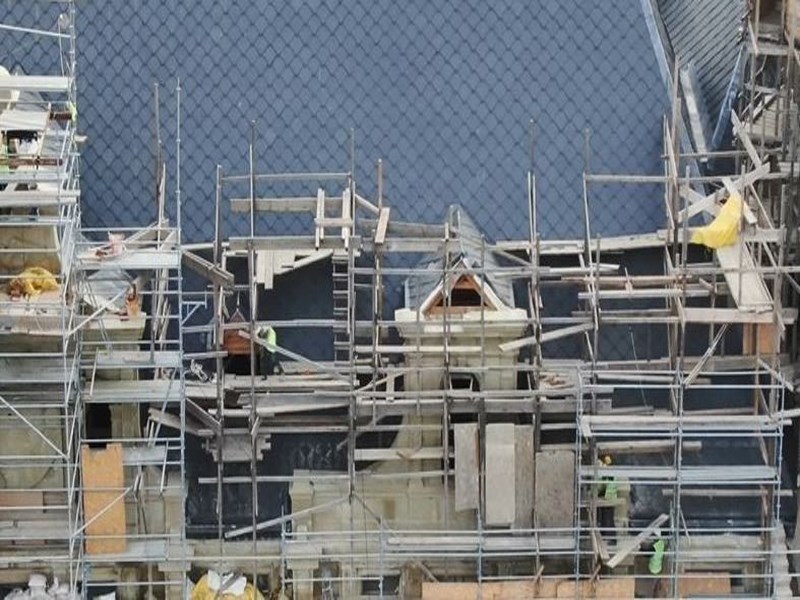
The entire steep roof of the station, built in the Neoclassical style, has been clad with black slate imported from Spain, remaining faithful to the original design.
Maritime-themed archaeology museum
The new archaeology museum, situated within the station grounds and boasting an enclosed area of approximately 10,000 square metres, is planned to have a maritime theme and to display selected artefacts brought from all 81 provinces of Turkey.
An event area with a capacity of approximately 20,000 people is also being created on the Haydarpaşa Station site. As part of the project, landscaping work will be carried out across an area of approximately 150,000 square metres. The Haydarpaşa waterfront will be reopened for public use.
Sources:
1. https://www.aa.com.tr/tr/kultur/kultur-ve-turizm-bakani-ersoy-haydarpasa-garindaki-restorasyon-calismalarini-inceledi/3948717
2. https://www.yarin11.com/tarihi-haydarpasa-garinin-dis-cephe-taslari-osmaneliden
3. https://www.cumhuriyet.com.tr/yasam/haydarpasa-gari-da-onunla-yapildi-osmaneli-lefke-tasina-cografi-isaret-2064747
4. Selim, H., Karakaş, A., & Coruk, Ö. (2019). Tarihi eserlerde doğal yapıtaşı olarak kullanılan Lefke taşının (Osmaneli/Bilecik) jeolojik ve mühendislik özellikleri. Dicle Üniversitesi Mühendislik Fakültesi Mühendislik Dergisi, 10(3), 1019-1032. https://doi.org/10.24012/dumf.521090 https://dergipark.org.tr/tr/download/article-file/818424
5. Avşaroğlu, N.(2020) Anadolu’nun Binlerce Yıllık Doğaltaşları. https://www.academia.edu/130346341/ANADOLUNUN_DO%C4%9EALTA%C5%9ELARI
6. https://www.kadikoy.gov.tr/haydarpasa-gari-ilcemiz
7. Korkmaz, T. & Ahunbay, Z. (2011). Haydarpaşa Garı'nın yapısal analizi ve taş koruma sorunları üzerine bir değerlendirme. Vakıf Restorasyon Yıllığı, 2(3), 45–62.
8. Maden Tetkik ve Arama Genel Müdürlüğü. (2018). Marmara Bölgesi endüstriyel hammadde ve doğal taş kaynakları envanteri (Yayın No. 412). MTA Genel Müdürlüğü.
9. Şenel, V. (2016). Osmanlı'dan cumhuriyete bir sanayi mirası: Hereke Fabrika-i Hümâyûnu ve tarihi dokusu. Kocaeli Büyükşehir Belediyesi Kültür Yayınları.
10. Engin, V. (2015). Hicaz ve Bağdat demiryolları: İmparatorluğun son büyük altyapı hamlesi (3. baskı). Yitik Hazine Yayınları.
Recent News
Street unearthed in Aspendos
Stoneline Publications’ third book: SELİMİYE
Sümela Monastery reopened to visitors

International Mustafa V. Koç Underwater Archaeology Symposium
#Prokonnesos quarry #Verde Antico #Marmor Docimium, Pavonazzetto, Afyon Violet
The Granikos Battlefield has been placed under protection
#Marmara marble #Prokonnesos marble #Granikos Battle
The Second Edition of Mimarlar İçin Doğal Taş Rehberi and the English Edition, Natural Stone Guide for Architects, Have Been Published
One of the main streets of Ancient Side has been unearthed
#conglomerate #Side Ancient City #Feriştah Alanyalı
The historic Yalı Pavilion is to be reconstructed
The theme of the Edirne Biennial: Bridges
A ‘stone hospital’ has been set up in Ephesus for the restoration of stones