Street unearthed in Aspendos
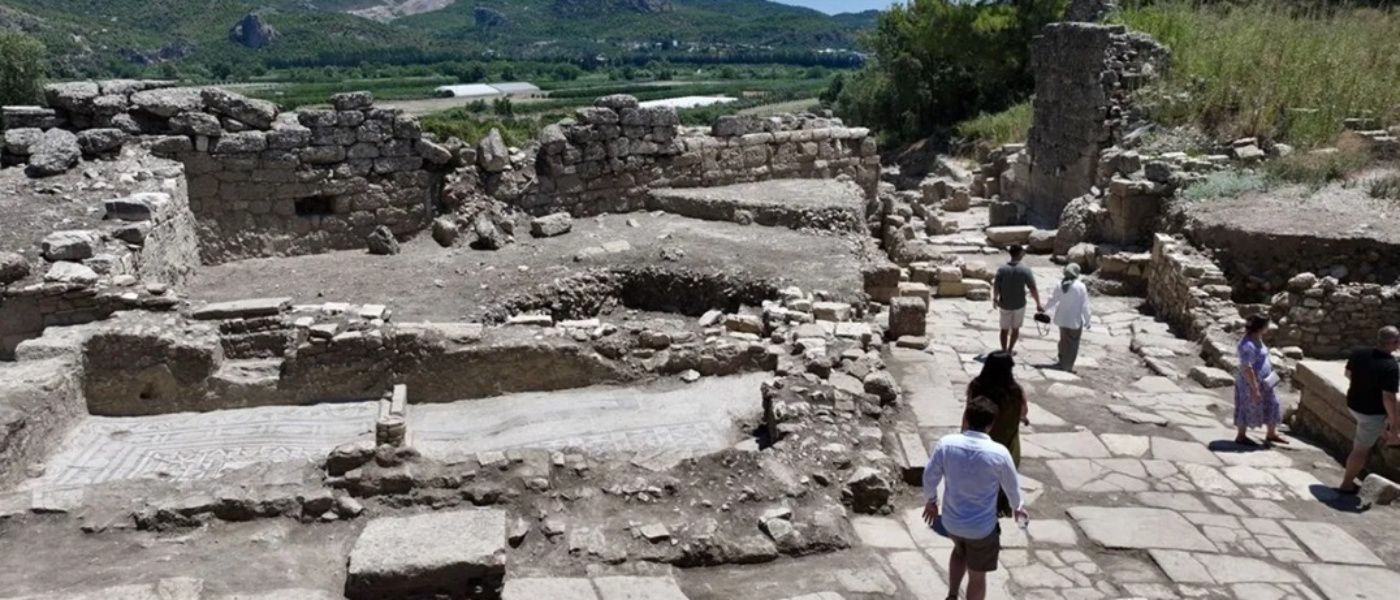
Excavations in Aspendos, one of Pamphylia’s major ancient cities, have been ongoing since 2022 under the leadership of Associate Professor Dr Mustafa Bilgin of Afyon Kocatepe University, as part of the Ministry of Culture and Tourism’s ‘Heritage for the Future Project’.
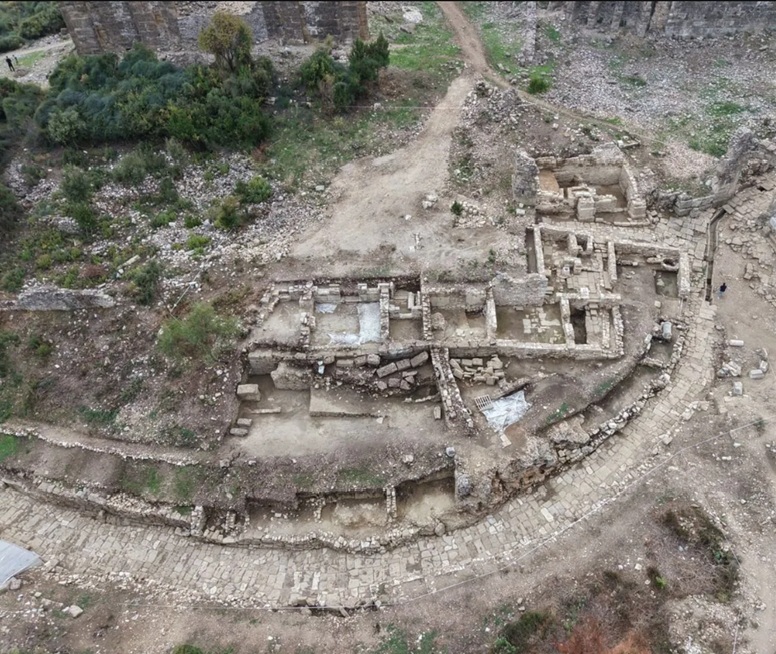
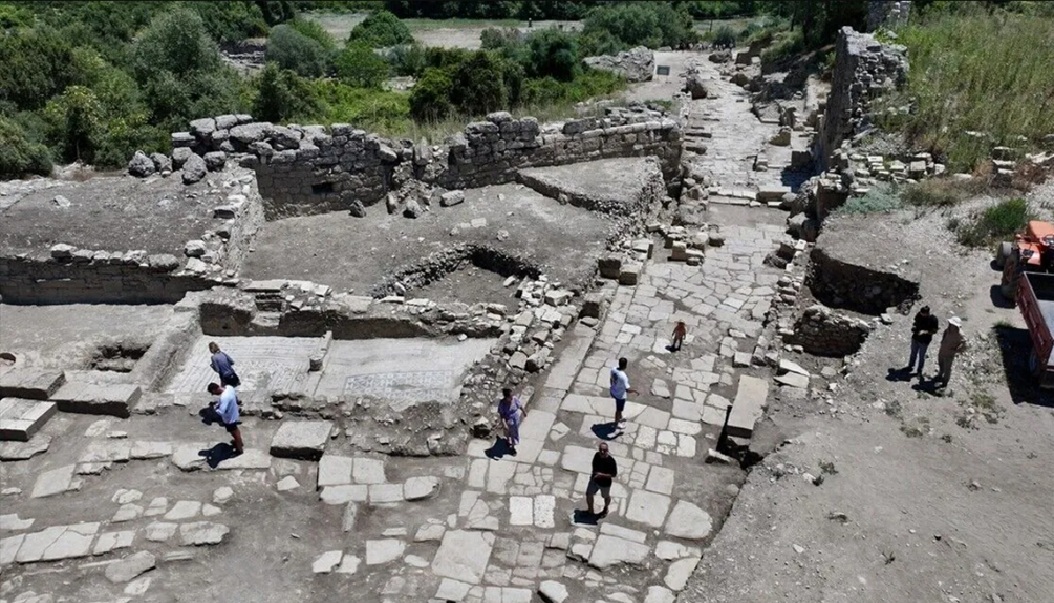
Associate Professor Dr Mustafa Bilgin told AA correspondent Süleyman Elçin that, as a result of the work carried out over the past two years on Theatre Street, an approximately 300-metre section of the road linking the ancient theatre to the Acropolis had been uncovered, and that significant finds had been uncovered along this route, including a well-preserved bread oven, public buildings, civilian dwellings, a monumental gate and evidence of an advanced infrastructure system. He also noted that, outside the eastern city gate, they had identified the city’s eastern necropolis, where a Classical-period tomb had been discovered. Bilgin also mentioned that they had uncovered the remains of a mosaic-lined structure in the Eastern Square. Highlighting the street’s remarkable engineering features, he explained, “The street’s width varies between 3 and 5 metres. Beneath it lies a drainage system approximately 1 metre deep. Thanks to the stone paving being laid in accordance with the gradient, no ground displacement has occurred despite earthquakes.”
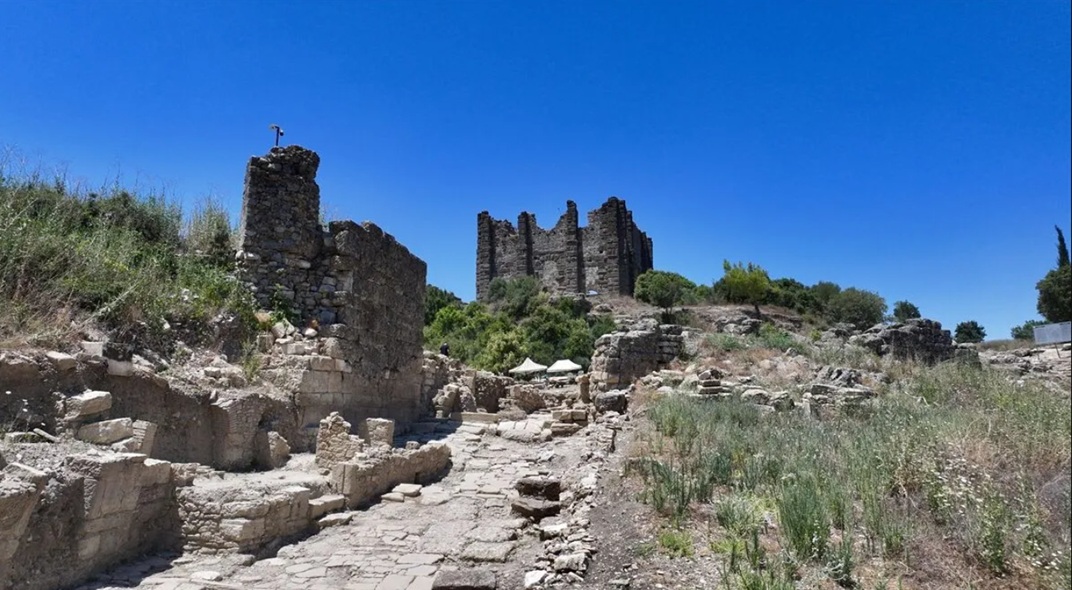
Bilgin stated that the finds uncovered on the street—which was one of the busiest urban transport routes in Aspendos during the ancient period—and in the complex of two-storey shops and the stoa provide insight into the city’s trade links within the Eastern Mediterranean region.[1]
“Heritage for the Future” in Aspendos
Mehmet Nuri Ersoy, Minister of Culture and Tourism, announced in a post on his social media account that another significant phase of the excavation work being carried out at the ancient city of Aspendos had been completed.
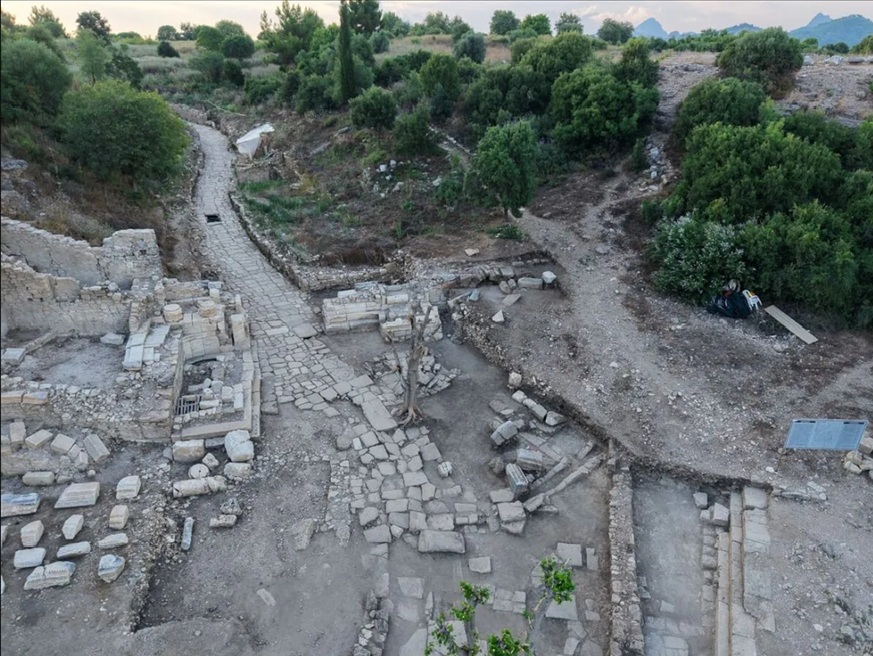
In his post, Minister Ersoy stated: “Through the excavation work we have been carrying out in Aspendos, we have uncovered a section of Theatre Street – one of the ancient city’s most important transport routes – spanning approximately 300 metres. Visitors will now be able to follow the traces of this millennia-old city step by step along this historic route stretching from the ancient theatre to the acropolis.”
Ersoy emphasised that the shops uncovered along the street, the bakery that has survived to the present day with its original architecture, the monumental eastern gate, the statues of Hermes, Artemis, Aphrodite, Eros and Nemesis, and the Young Eurymedon Mosaic open a new window onto Aspendos’ rich history.
Theatre Street
According to a statement from the Ministry of Culture and Tourism, the street—which runs from the north of the Agora to the ancient theatre—follows the valley between the Roman State Basilica and the Temple, leading to the Eastern Square and, from there, to the city gate on the eastern walls.
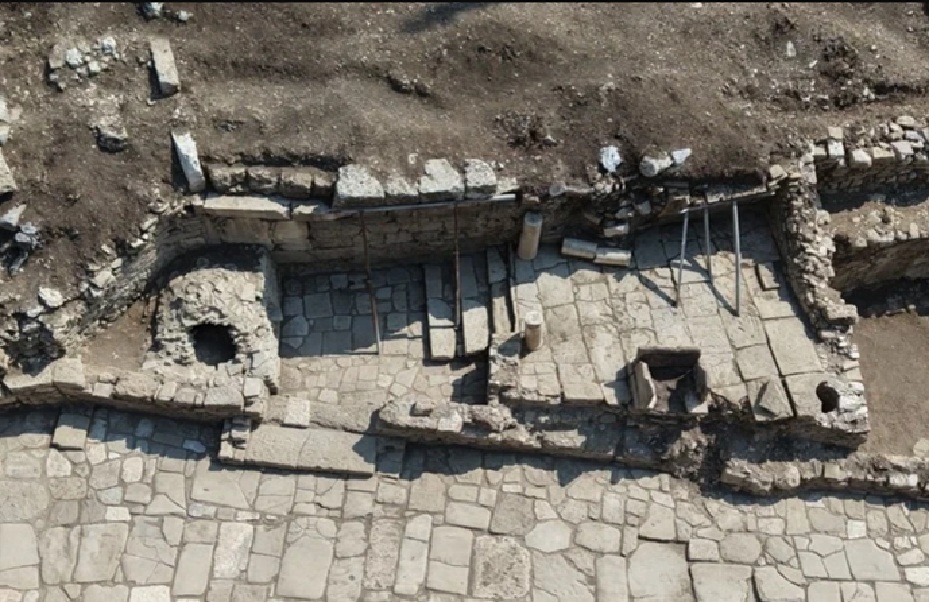
Shop entrances and connections to side streets were also uncovered during the excavations on Theatre Street, which varies in width between 3 and 5 metres. The bakery, situated on the northern side of the street and preserved in its entirety to the present day, was among the most striking finds of the excavations.
Furthermore, it was determined that the walls on either side of the road, which reach a height of 2.5 metres in some sections, were constructed using the ‘opus mixtum’ technique, which combines stone and brick.
To the south of the structure identified as the ‘Theatre Street Eastern Monumental Gate’, an exedra-plan fountain and two structures built on a terrace were identified.
During the excavations, statues of Hermes, Artemis, Aphrodite, Eros and Nemesis, along with geison-sima blocks, fragments of architraves and numerous architectural elements, were unearthed.
The findings indicate that the structure was built between the end of the 2nd century AD and the beginning of the 3rd century AD.
The mosaic depicting the River God of Aspendos, the Young Eurymedon, found on the floor of the pool-bearing structure in the Eastern Square, was also among the site’s most notable discoveries.
The geological formation beneath Aspendos
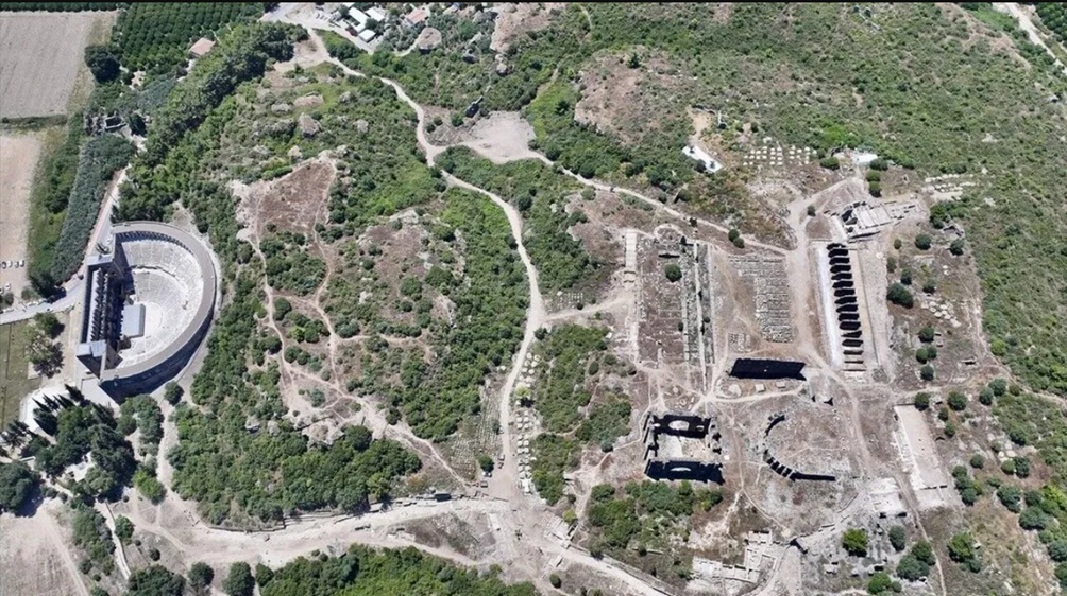
The acropolis (upper city) of the ancient city of Aspendos is situated on river terraces and karstic conglomerate/travertine (limestone) formations dating geologically to the Quaternary period. The acropolis hill is a hard, rugged and steep plateau (natural platform) formed by the deposition of alluvial deposits carried by the Köprüçay (Eurymedon) over thousands of years, combined with the precipitation of calcium carbonate-rich waters. [2, 3]
Natural stones used in Aspendos’s construction
In some of the Aspendos structures identified as a result of recent excavations, and more particularly in the world-famous Aspendos Theatre and the aqueducts, three main types of natural stone were used: [2]
Local Porous Limestone (Travertine / Conglomerate): This is the main material used in the theatre’s massive outer walls, load-bearing vaults, arches and the city’s aqueduct towers. It is a durable, grey-beige stone that can be cut into blocks. [2]
Korkuteli Beige (Limestone / Marble-like Limestone): A durable, white/cream-coloured limestone with a finer grain and high workability, used in the theatre’s seating tiers (cavea) and steps. [2, 4]
Dokimeion Marble (Afyon Marble) and Coloured Imported Marbles: These were used on the ornate columns, sculptures and architectural reliefs on the interior surfaces of the theatre’s stage building (skene). [2]
Sources of the natural stones used in the theatre
Main Building Stones (Limestone / Travertine): The large limestone blocks forming the theatre’s walls (and forming also the aqueducts) were quarried from local quarries (ancient Pamphylian limestone formations) in the immediate vicinity of the city and around Serik.
Seating Rows (Cavea): As confirmed by laboratory analyses both in antiquity and during modern-day restorations, these stones were sourced from ancient quarries in and around the Korkuteli district of Antalya.
Decorative Marbles: The main marbles adorning the area behind the stage were transported by river and sea (via the Köprüçay) from the quarries at Afyonkarahisar–İscehisar (Dokimeion), the most famous marble quarry in the ancient world. [2, 4, 6]
Photos(Cover,1,6,7): Kasım Sakallı / AA
Notes and References:
1. https://www.aa.com.tr/tr/kultur/aspendosun-yaklasik-2-bin-yillik-ana-caddesi-yeniden-hayat-buldu/4004388
2. Kıraç, A. & Kıraç, R. (2011/2019): "Jeolojik Miras Niteliğindeki Doğal Taşların Peyzaj Mimarlığında Kullanımı" (https://dergipark.org.tr/en/download/article-file/741990).
3. Köse, V., Bilgin, M., Kopçuk, İ. (2024): "Aspendos’tan 12. Yüzyıla Tarihlendirilen Bir Depolama Birimi ve Kentin Akdeniz Ticaretindeki Yeri Üzerine Yeni Bulgular", Türk Tarih Kurumu - Höyük Dergisi. (https://hoyuk.gov.tr/eng/full-text/118/tur)
4. https://bianet.org/haber/bakanliktan-aspendos-restorasyonu-aciklamasi-167899#google_vignette
T.C. Kültür ve Turizm Bakanlığı & Antalya Kültür Varlıklarını Koruma Bölge Kurulu Raporları (2015): Aspendos Tiyatrosu Restorasyon Analiz Laboratuvarı Sonuçları.
5. Mansel, Arif Müfid (1956): "İlk Çağda Antalya Bölgesi (Pamphylia) Tarihi ve Eserleri" (Türk Tarih Kurumu Yayınları).
6. https://ukaas.ktb.gov.tr/Eklenti/133251,40-arastirma-sonuclari-toplantisi3pdf.pdf?0
Recent News
Restoration of Haydarpaşa Station continues
#Haydarpaşa Train Station #Lefke Stone (sandstone) #Hereke Granite
Stoneline Publications’ third book: SELİMİYE
Sümela Monastery reopened to visitors

International Mustafa V. Koç Underwater Archaeology Symposium
#Prokonnesos quarry #Verde Antico #Marmor Docimium, Pavonazzetto, Afyon Violet
The Granikos Battlefield has been placed under protection
#Marmara marble #Prokonnesos marble #Granikos Battle
The Second Edition of Mimarlar İçin Doğal Taş Rehberi and the English Edition, Natural Stone Guide for Architects, Have Been Published
One of the main streets of Ancient Side has been unearthed
#conglomerate #Side Ancient City #Feriştah Alanyalı
The historic Yalı Pavilion is to be reconstructed
The theme of the Edirne Biennial: Bridges
A ‘stone hospital’ has been set up in Ephesus for the restoration of stones